
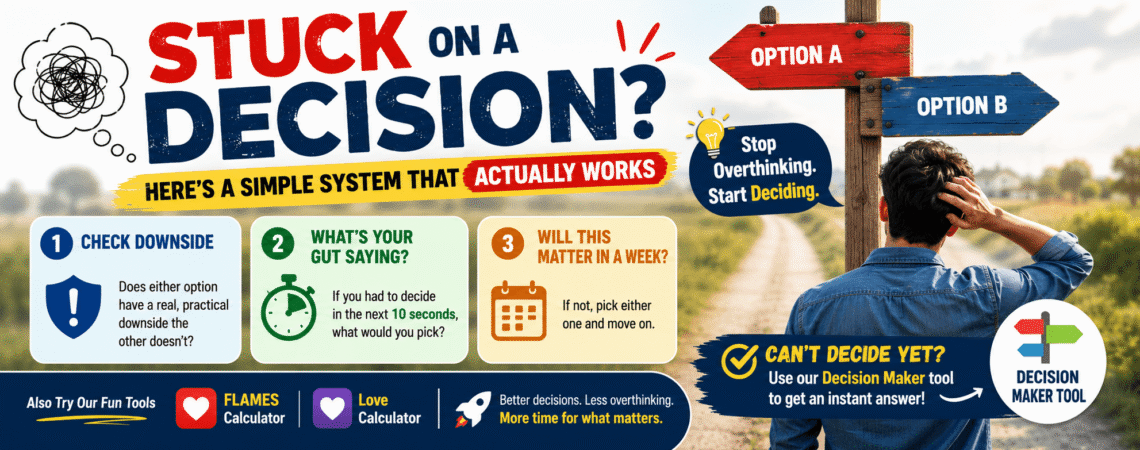
If you’re stuck on a decision that shouldn’t be this hard, you’re not alone. You know the feeling. Two options, both fine, neither obviously better — and somehow you’ve spent twenty minutes going back and forth without getting any closer to picking one. It’s not that the decision is actually that hard. It’s that your brain keeps re-running the same comparison over and over, hoping a “correct” answer will suddenly appear.
It won’t. Most everyday decisions don’t have one objectively correct answer — that’s exactly why they feel stuck. The fix isn’t more thinking. It’s a system that forces a conclusion.
Here’s one that actually works, plus what to do when even the system doesn’t help.
Why We Get Stuck on Small Decisions
This has a name — choice paralysis (sometimes called analysis paralysis) — and it happens for a few predictable reasons:
- Too many similar options. When choices are genuinely close in value, your brain doesn’t have a clear signal to latch onto, so it loops.
- Fear of the wrong choice. Even low-stakes decisions can trigger this if you’re someone who dislikes regret.
- No deadline. Without a forcing function, there’s no cost to continuing to deliberate — so you do, indefinitely.
- Decision fatigue. If this is your fortieth choice of the day, your brain has less capacity left to commit to any of them.
None of these mean the decision itself is hard. They mean your process for deciding is missing something.
The 3-Question System
Instead of re-comparing the options endlessly, run them through three questions in order. Stop as soon as one gives you a clear answer.
1. Does either option have a real, practical downside the other doesn’t?
Not a preference — an actual cost. Money, time, risk, something irreversible. If one option is clearly worse on a concrete axis, you’re done. Most “stuck” decisions don’t actually have this, which is exactly why they feel stuck — but it’s worth ruling out first.
2. If you had to decide in the next 10 seconds, what would you pick?
This sounds like a gimmick, but it’s genuinely useful: your gut reaction under time pressure usually reveals a preference your slower, more careful thinking has been talking you out of. Whatever you blurt out first is data — it’s not nothing.
3. Will this matter in a week?
If the honest answer is no, the decision isn’t actually worth more deliberation than you’ve already given it. Pick either one and move on. The energy you’re spending trying to find the “right” answer is worth more than the marginal difference between two fine options.
What If You’re Still Stuck After All Three?
That’s a signal, not a failure. If a decision survives all three questions and you’re still frozen, it usually means one of two things:
- The options genuinely are close to equal in value — in which case, by definition, you can’t make a wrong choice. Flip a coin, or use a random picker, and commit.
- You’re not actually stuck on the decision itself — you’re anxious about something else (what others will think, a pattern of regretting past choices, general overwhelm) and this particular decision is just where it’s surfacing. That’s worth noticing on its own.
When a Random Nudge Is the Right Answer, Not a Cop-Out
There’s a common belief that using a coin flip or random picker to decide something means you didn’t take it seriously. Usually the opposite is true. If you’ve already established the options are genuinely close — no real downside difference, no strong gut pull, low long-term stakes — then continuing to deliberate isn’t rigor, it’s just friction. A random nudge at that point is the efficient choice, not a lazy one.
This is really what a decision-making tool is for: not replacing judgment, but stepping in at the exact point where more judgment stops adding value.
Try It
If you’ve run through the questions above and you’re still circling, our Decision Maker tool will make the call instantly — enter your options and let it pick, so you can stop spending energy on a choice that’s already this close to a coin flip.
If it’s specifically a “would we get along” or compatibility-style decision, you might also like the FLAMES Calculator or Love Calculator for a lighter-hearted version of the same idea.
More tools on MiscCalc: Decision Maker · FLAMES Calculator · Love Calculator · Random Number Generator
Frequently Asked Questions
Is it bad to let a random tool decide something important?
For genuinely high-stakes decisions — career, health, major financial choices — no, don’t outsource those to randomness. This approach is meant for the everyday, low-stakes decisions that eat up disproportionate mental energy, not the big ones.
What if I regret the choice afterward?
Regret after a close call usually isn’t a sign you picked wrong — it’s a normal side effect of not being able to see the road not taken. If both options were genuinely close, the version of you that picked the other one would likely feel a version of the same thing.
Why does deciding fast sometimes feel better than deciding slow?
Because prolonged deliberation on a close decision doesn’t actually improve the outcome — it just extends the discomfort. Once you’ve ruled out a real downside (question one), speed stops costing you anything.
Is choice paralysis the same as being indecisive as a personality trait?
Not necessarily — most people experience it situationally, especially with unfamiliar decisions or too many similar options, rather than it being a fixed trait.
Does this work for decisions with more than two options?
Yes — the same three questions apply, you’re just screening a longer list down instead of comparing a pair. Eliminate anything with a real downside first, then apply the gut-check and the “will it matter” questions to what’s left.