
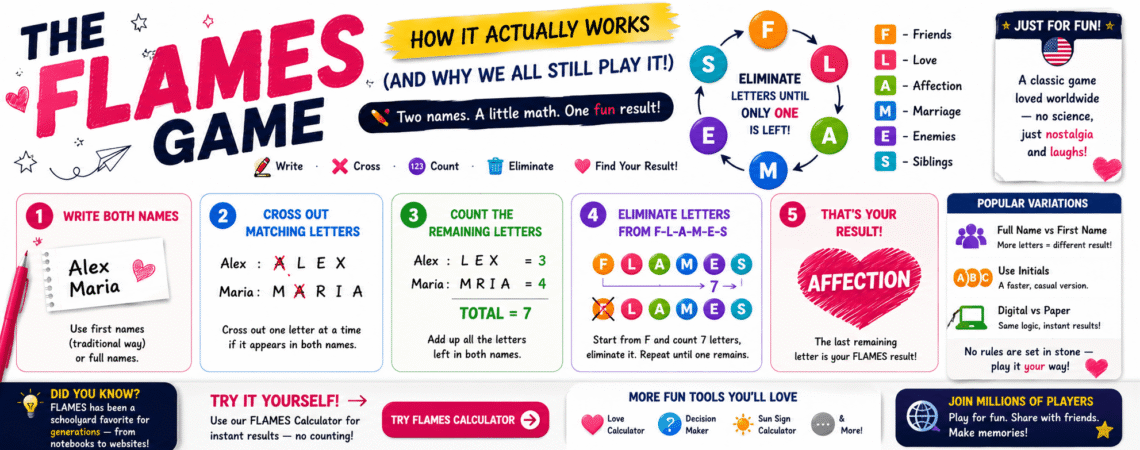
If you grew up passing notes in class, you’ve probably scribbled two names on a piece of paper, crossed out the matching letters, and counted your way down to a single word: Friends, Love, Affection, Marriage, Enemies, or Siblings. That’s FLAMES — and somehow, decades later, it’s still one of the most searched relationship “games” on the internet.
It’s not real science. Nobody’s claiming it is. But the logic behind it is a genuinely fun bit of simple math, and understanding how it works makes the game more interesting, not less.
What FLAMES Actually Stands For
Each letter represents a possible outcome between two people:
- F — Friends
- L — Love
- A — Affection
- M — Marriage
- E — Enemies
- S — Siblings
You start with all six letters, and the counting method eliminates them one by one until only one is left. That final letter is your “result.”
How to Play It (The Original Pen-and-Paper Way)
- Write both names — first names are traditional, though some versions use full names.
- Cross out matching letters. Go letter by letter through the first name and the second name, crossing out one instance of each letter that appears in both. For example, if both names contain the letter “A,” cross out one “A” from each name, even if there are multiple.
- Count the remaining letters. Add up every letter left uncrossed across both names. That total number is what you’ll use to eliminate FLAMES letters.
- Eliminate letters from F-L-A-M-E-S in a loop. Starting from “F,” count around the letters using your number from step 3, removing the letter you land on each time. Keep looping through the remaining letters until only one is left.
- That final letter is your result.
It sounds more complicated written out than it is in practice — most people can do it in under a minute once they’ve tried it a couple of times.
A Quick Worked Example
Let’s use “Alex” and “Maria”:
- Alex: A, L, E, X
- Maria: M, A, R, I, A
Matching letters: A appears in both — cross out one A from each.
- Remaining in Alex: L, E, X
- Remaining in Maria: M, R, I, A
Total remaining letters: 3 + 4 = 7
Now count around F-L-A-M-E-S in a loop, eliminating the 7th letter each time, until one letter remains. Depending on the loop, you’d land somewhere in the six — maybe “Affection,” maybe “Enemies.” The fun part is that a single letter difference in either name changes the entire outcome.
Doing this by hand is satisfying once, but tedious if you’re testing it with five different names to see who gets “Love.” That’s really what a FLAMES calculator is for — same exact logic, just instant.
Where Did FLAMES Come From?
Nobody has a confirmed origin story for FLAMES — it’s the kind of thing that spread through schoolyards long before the internet existed, similar to MASH (Mansion, Apartment, Shack, House) or paper fortune tellers. It became genuinely massive in South Asian schools in particular, and carried straight over into the internet age as one of the earliest “fun calculator” websites people searched for.
It sits in the same category as horoscopes and love-compatibility quizzes: nobody treats the result as a literal prediction, but the process of finding out is entertaining enough that it never really went away.
Does FLAMES Actually Mean Anything?
Not scientifically, no. It’s a deterministic algorithm — the same two names will always produce the same result, every single time. There’s no randomness and no real relationship data involved. If you and a friend both ran the same two names, you’d get the identical answer.
That said, there’s a reason games like this stick around for generations: they’re a low-stakes way to talk about relationships, tease friends, or just kill five minutes. Treat it the way you’d treat a fortune cookie — fun context, not a verdict.
FLAMES Variations You Might Run Into
- Full name vs. first name only — using full names (including middle names) changes results significantly, since more letters means more elimination rounds.
- FLAMES with initials — a faster, less personal version some people use for group games.
- Digital vs. paper versions — modern calculators sometimes add flourishes (compatibility percentages, extra categories) that weren’t part of the original game.
None of these are “more correct” than the others — it’s the same core idea with different flavor.
Try It Yourself
Doing this by hand for one pair of names is fun. Doing it by hand for six different name combinations because your friend group won’t stop arguing is not. Our FLAMES Calculator runs the exact algorithm above instantly — just enter two names and get your result without counting a single letter.
If relationship-adjacent tools are your thing, you might also enjoy the Love Calculator or the Decision Maker for literally anything else you can’t decide on.
Frequently Asked Questions
Does the order of the names matter? No — FLAMES is symmetric. Whether you write your name first or your friend’s name first, the matching-letter elimination process produces the same result either way.
What if two letters end up tied at the end? They won’t — the elimination process always narrows down to exactly one letter, as long as you follow the counting method consistently through each round.
Can I use nicknames instead of full names? Yes, and honestly, that’s part of the fun — different name spellings genuinely change the result, so “Alexander” and “Alex” won’t necessarily land on the same letter.
Is there a “best” result? Not really — it depends what you’re hoping for. Most people root for Love or Marriage and groan at Enemies, but it’s worth remembering this is a schoolyard game, not a prediction.
Why do some versions only use five letters instead of six? A few regional variants drop “Siblings” and use just Friends, Love, Affection, Marriage, and Enemies. Both versions are common — there’s no single “official” ruleset.
More tools on MiscCalc: FLAMES Calculator · Love Calculator · Decision Maker · Sun Sign Calculator