
If you’ve ever sat at a restaurant table staring at the check, mentally trying to figure out what 18% of $67.40 actually is — you’re not alone. Tipping in the United States is genuinely confusing, and not just because the math is annoying. The rules keep shifting. Screens at coffee shops now ask for 30%. Fast food counters have tip prompts. Your pizza tracker shows a tip slider before the driver has even left.
This guide cuts through all of that. Here’s how to quickly calculate a tip, what’s actually expected where, and when it’s genuinely okay to skip it.
The Fastest Way to Calculate a Tip
You don’t need to be a math whiz. Here are three methods that work in your head, no phone required:
The 10% method (then adjust): Move the decimal point one place to the left. That’s 10% of your bill.
- $65 bill → $6.50 is 10%
- For 15%: take 10% and add half of that ($6.50 + $3.25 = $9.75)
- For 20%: just double the 10% figure ($6.50 × 2 = $13.00)
The double-the-tax trick (US specific): In most US states, sales tax runs between 6–10%. Double your tax amount and you’re in the 15–20% tip range. It’s not perfectly accurate but it’s fast and close enough.
The decimal method: Multiply your bill by 0.15, 0.18, or 0.20 — whichever percentage you’re aiming for.
- $67.40 × 0.18 = $12.13
- $67.40 × 0.20 = $13.48
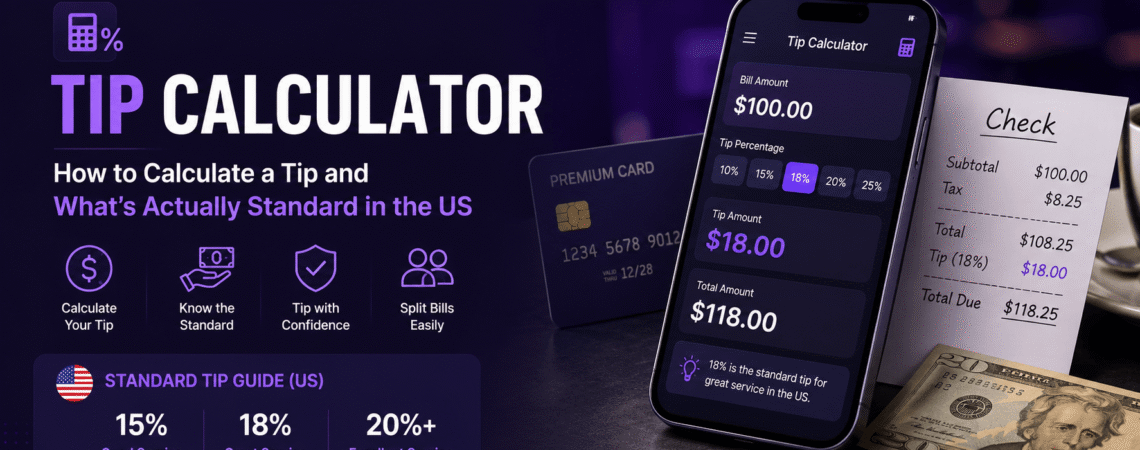
Or just use our Tip Calculator — enter the bill amount, choose your percentage, and split it however many ways you need. Done in three seconds.
Should You Tip on the Pre-Tax or Post-Tax Amount?
This comes up more than you’d think. The technically correct answer is pre-tax — the tip is meant to compensate your server for their service, and the sales tax is a government charge that has nothing to do with them.
In practice, the difference on most bills is less than a dollar, and most people don’t bother separating it. Either approach is socially acceptable. If you’re being precise, calculate on the subtotal. If you’re just being practical, calculating on the total is fine.
US Tipping Standards in 2026 — What’s Actually Expected
Sit-Down Restaurants
The baseline has moved. The standard restaurant tip is now 15–20% of the pre-tax bill, with 20% being the current baseline for good service.
A practical breakdown:
- 15% — minimum for acceptable service; below this sends a message
- 18% — solid, still considered slightly below standard in many cities
- 20% — the new normal for good service
- 25%+ — exceptional service, or when you want to show real appreciation
One important reminder: always check your bill before adding a tip. Some restaurants automatically include gratuity for larger parties — usually eight or more. It’s easy to miss that and tip twice by accident.
If your food was wrong or came out cold, that’s usually a kitchen issue — not your server’s fault. They don’t cook the food. Speak to a manager about the food, but don’t punish the server’s tip for a problem they couldn’t control.
Bars and Nightlife
Tip $1 per drink for beer or wine. For cocktails, which take more time and expertise, tip at least 18–20% of your bill. If you know you’ll be ordering multiple drinks over the course of a night, tipping $5 on the initial drink and then $1 for each drink after is a good way to set a positive tone with your bartender.
Food Delivery
For food deliveries, it’s customary to tip $3–$5 or approximately 15–20% of the order total, especially during peak times or bad weather.
The tip on delivery apps often goes directly to the driver — not the restaurant. Drivers cover their own gas and vehicle wear. On a $30 order, $5–6 is reasonable. On a larger order, 15–20% applies.
Coffee Shops and Counter Service
This is the one people argue about most. The honest answer: tips are not required at counter-service restaurants or for simple takeout orders. Counter-service workers likely already receive a full hourly wage, unlike waitstaff.
That said, if someone makes your complicated custom order or you’re a regular at a neighborhood spot, tipping a dollar or two is a nice gesture — not an obligation.
Hotel Staff
Often overlooked, but these workers depend on tips too:
- Bellhop / luggage: $1–2 per bag
- Housekeeping: $2–5 per night, left daily (not just at checkout — different staff may clean on different days)
- Valet: $2–5 when they return your car
- Room service: Check the bill — if a service charge is already included, an extra tip is optional but appreciated
Other Services
| Service | Standard Tip |
|---|---|
| Hair salon / barber | 15–20% |
| Massage therapy | 15–20% |
| Nail salon | 15–20% |
| Taxi / rideshare | 10–15% (often prompted in-app) |
| Airport / hotel shuttle | $1–2 per person |
| Tour guide | $5–10 per person for group tours |
| Moving company | $20–50 per mover for a full-day move |
Why Tipping Matters More in the US Than Anywhere Else
If you’re from outside the US, the American tipping culture can feel extreme. In most countries, service workers are paid a living wage and tips are a genuine bonus. In the US, the situation is different.
Federal law still allows employers to pay tipped workers as little as $2.13 per hour — a rate that hasn’t changed since 1991. Tips aren’t optional extras; for most servers and bartenders, they make up the majority of actual take-home income.
This doesn’t mean you should tip regardless of service quality — but it does mean that skipping a tip entirely, except in genuinely poor service situations, has a real impact on someone’s ability to pay their bills.
What Changed in 2026
There’s one new development worth knowing: the One Big Beautiful Bill Act created a federal deduction for 100% of qualified tip income, effectively eliminating federal income tax on tips for most tipped workers. This is a significant change for servers, bartenders, and delivery drivers — their take-home from tips goes further than it did before. It doesn’t change what you should tip, but it’s useful context.
When It’s Genuinely Okay Not to Tip
Tipping culture has expanded — sometimes uncomfortably — into situations where it wasn’t traditionally expected. Here’s a reasonable framework:
Skip the tip (or keep it minimal) when:
- You’re picking up a simple takeout order you placed online
- You’re at a fast food counter where you order and pick up at the window
- A self-service kiosk presents a tip screen (these are common now — it’s okay to select “no tip” without guilt)
Always tip when:
- A person brought food or drinks to your table
- Someone delivered to your door
- A professional provided a personal service (haircut, massage, nails)
- Someone carried your bags or parked your car
The general principle: if a person provided active service that made your experience better, a tip is expected. If you mostly served yourself with minimal human interaction, it’s genuinely optional.
The Math, Made Simple
Here’s a quick reference for common bill amounts at different tip percentages:
| Bill Amount | 15% Tip | 18% Tip | 20% Tip | 25% Tip |
|---|---|---|---|---|
| $20 | $3.00 | $3.60 | $4.00 | $5.00 |
| $40 | $6.00 | $7.20 | $8.00 | $10.00 |
| $60 | $9.00 | $10.80 | $12.00 | $15.00 |
| $80 | $12.00 | $14.40 | $16.00 | $20.00 |
| $100 | $15.00 | $18.00 | $20.00 | $25.00 |
| $150 | $22.50 | $27.00 | $30.00 | $37.50 |
For anything not on this table — or to split a tip between multiple people — use our Tip Calculator. You can also use our Percentage Calculator if you want to work out any custom percentage quickly.
Frequently Asked Questions
Should I tip on alcohol? Yes, in most cases. Expensive bottles of wine are sometimes tipped at a lower percentage, but cocktails, beer, and standard drinks follow the same 15–20% guideline as food.
What if I use a coupon or discount? Tip on the original pre-discount amount. Your server did the same amount of work regardless of whether you had a deal. If your $60 meal drops to $40 with a coupon, tip on $60.
What about bad service? If service was genuinely poor, 10–15% communicates your dissatisfaction while still acknowledging that the person worked. Leaving nothing is a strong statement and usually reserved for situations that were truly unacceptable. When in doubt, speak to a manager — many restaurants will address the problem directly.
Is tip-pooling common? Very. Many restaurants pool tips and distribute them among servers, bussers, food runners, and sometimes kitchen staff. Your tip doesn’t always stay with just your server — it often supports the whole team that contributed to your experience.
Do I tip at buffets? Yes — 10–15% is standard at buffets. Staff still clears plates, refills drinks, and manages the dining room. Less work than full table service, but still deserving of a tip.
Learn More From Trusted Sources
The US Department of Labor provides official information on tipped minimum wage laws by state — useful if you want to understand exactly how server pay works across different parts of the country: DOL — Tipped Employees
For a broader view of tipping etiquette across different social situations, the Emily Post Institute has been the US authority on social customs for over a century: Emily Post — Tipping Etiquette
More tools on MiscCalc: Tip Calculator · Discount Calculator · Percentage Calculator · Currency Converter