
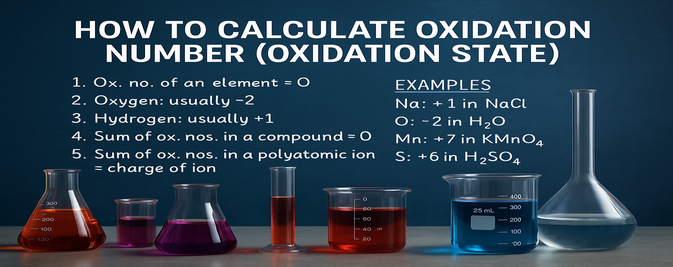
The oxidation number (or oxidation state) tells us how many electrons an atom has gained, lost, or shared in a chemical compound.
It’s one of the most important concepts in chemistry, redox reactions, balancing equations, and inorganic chemistry.
The good news?
👉 Once you learn a few simple rules, calculating oxidation numbers becomes extremely easy.
Let’s break it down step-by-step with examples.
⭐ What is Oxidation Number?
The oxidation number represents the charge an atom would have if electrons were completely transferred.
Examples:
- Na in NaCl has an oxidation number of +1
- Cl in NaCl has an oxidation number of 1
- O in most compounds has –2
It helps in:
✔ Balancing redox reactions
✔ Identifying oxidation & reduction
✔ Predicting reaction products
✔ Understanding electron transfer
⭐ General Rules to Calculate Oxidation Number
Oxidation Number Calculator
Enter a chemical formula and the overall ionic charge (0 for neutral). The tool will let you choose an element to solve for and will pre-fill common oxidation states — you can override them.
Memorize these, and you can solve any question.
Rule 1: The oxidation number of any free element is 0
Examples:
- H₂ → 0
- O₂ → 0
- Fe (solid iron) → 0
- Cl₂ → 0
Rule 2: The oxidation number of a monoatomic ion = its charge
Examples:
- Na⁺ → +1
- Mg²⁺ → +2
- Cl⁻ → –1
Rule 3: Oxygen is usually –2
Examples:
- H₂O → O = –2
- CO₂ → O = –2
Exceptions:
- Peroxides (H₂O₂): O = –1
- OF₂: O = +2
Rule 4: Hydrogen is usually +1
Exceptions:
- In metal hydrides (NaH, CaH₂), H = –1
Rule 5: Fluorine is always –1
(Highest electronegativity)
Rule 6: The sum of oxidation numbers in a neutral compound = 0
Example:
H₂O → (2 × +1) + (–2) = 0
Rule 7: The sum of oxidation numbers in a polyatomic ion = ion charge
Example (SO₄²⁻):
Sum = –2
⭐ Step-by-Step: How to Calculate Oxidation Number
Let’s apply the rules.
🧮 Example 1: Find the oxidation number of Mn in KMnO₄
We know:
- K = +1
- O = –2
Let Mn = x
Equation:
(+1) + x + 4(–2) = 0
1 + x – 8 = 0
x – 7 = 0
x = +7
👉 Mn in KMnO₄ = +7
🧮 Example 2: Oxidation number of Cr in Cr₂O₇²⁻
Let Cr = x
Sum of oxidation numbers = –2
O = –2
Equation:
2x + 7(–2) = –2
2x – 14 = –2
2x = 12
x = +6
👉 Cr = +6
🧮 Example 3: Oxidation number of S in H₂SO₄
H = +1
O = –2
Let S = x
Equation:
2(+1) + x + 4(–2) = 0
2 + x – 8 = 0
x – 6 = 0
x = +6
👉 Sulfur = +6
🧮 Example 4: Oxidation number of N in NO₃⁻
Let N = x
O = –2
Charge = –1
Equation:
x + 3(–2) = –1
x – 6 = –1
x = +5
👉 Nitrogen = +5
🧮 Example 5: Oxidation number of Cl in HClO
H = +1
O = –2
Let Cl = x
Equation:
(+1) + x + (–2) = 0
x – 1 = 0
x = +1
👉 Cl = +1
⭐ Shortcut Trick to Save Time
Memorize these common oxidation states:
Element Usual Oxidation Number
H +1 (–1 in hydrides)
O –2 (–1 in peroxides)
F –1
Alkali metals (Group 1) +1
Alkaline earth metals (Group 2) +2
Al, Zn +3, +2
Halogens –1 (except with oxygen)
⭐ How to Identify Oxidation & Reduction
- Oxidation = Increase in oxidation number
- Reduction = Decrease in oxidation number
Example:
Fe²⁺ → Fe³⁺
(+2 → +3) = oxidation
Cl₂ → Cl⁻
(0 → –1) = reduction
⭐ Common Mistakes Students Make
❌ Confusing oxidation number with valency
❌ Forgetting the peroxide exception
❌ Not applying the overall charge rule
❌ Forgetting hydrogen is -1 in metal hydrides
⭐ Conclusion
Understanding oxidation numbers is straightforward with a few fixed rules. Practice with 7 to 10 compounds daily, and you’ll master redox reactions easily.