
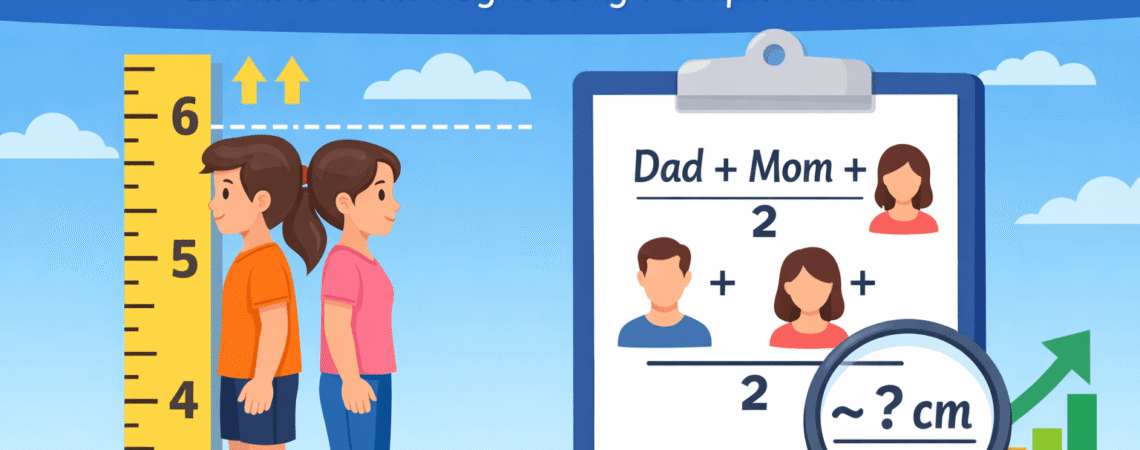
Many people are curious about how tall they might become in the future. Parents often wonder the same thing about their children. While no tool can predict height with complete accuracy, a height predictor can give a rough idea based on commonly used growth formulas.
This page explains how height estimation works, what the results actually mean, and how you should look at them — without making any medical claims.
A Quick Note Before You Use the Tool
This height predictor is meant for general estimation only.
It does not provide medical advice, diagnosis, or guaranteed results.
Think of it as a reference point, not a final answer.
Height Predictor Calculator
Height Predictor
Estimate adult height using a general growth formula. Results are approximate.
Disclaimer: This height predictor provides an estimated result based on general growth formulas. It is for informational purposes only and not medical advice.
The calculator above estimates adult height using parental heights. The result you see is an approximate value, and real-life height may turn out to be slightly higher or lower.
If you’re exploring body measurements or estimation tools, you may also find these calculators useful:
- BMI Calculator – Check body mass index based on height and weight.
- Age Calculator – Calculate exact age in years, months, and days.
- Gender Predictor – A fun, curiosity-based predictor often used during pregnancy.
- Chinese Gender Calendar – Explore a traditional method people use just for interest.
How Height Estimation Actually Works
Many things influence height, but genetics play the biggest role. That’s why most basic height estimation methods start with the parents’ heights.
Over time, researchers observed that children’s adult height often falls somewhere around the average of their parents’ heights, with a small adjustment based on gender. That’s the idea behind the formula used in this calculator.
It’s simple, and that’s also why it should be taken lightly — it gives direction, not certainty.
The Formula Used in This Height Predictor
This tool uses what’s commonly called the mid-parental height formula.
- For males, a small value is added before averaging
- For females, a small value is subtracted
This adjustment reflects average differences observed in growth patterns. The final result is shown in centimeters.
Again, this is a general calculation, not a promise.
Example: What the Calculation Looks Like
Let’s look at a real example to make this easier to understand.
Example 1: Male
- Father’s height: 175 cm
- Mother’s height: 162 cm
After applying the formula, the estimated adult height comes out to around 175 cm.
That doesn’t mean the person will stop growing at exactly that height. It just shows a possible outcome based on averages.
Example 2: Female
- Father’s height: 170 cm
- Mother’s height: 160 cm
The estimated adult height in this case is around 158.5 cm.
Some people grow taller than the estimate, some shorter — both are completely normal.
Why Actual Height Can Be Different
Even with genetics playing a big role, height is not fixed by formula alone.
Other factors that may influence growth include:
- Nutrition during childhood and teenage years
- Overall lifestyle and physical activity
- Environmental conditions
- Natural differences in growth timing
Because of this, two people with similar inputs can still end up at different heights.
So… How Accurate Is a Height Predictor?
The honest answer: it’s approximate.
A height predictor is useful for:
- Curiosity
- General understanding
- Educational reference
It should not be used to make health decisions or assumptions about growth problems.
Common Questions People Ask
Can this tool predict the exact height?
No. It provides an estimate, not an exact value.
Does this work for everyone?
It works as a general reference, but individual results may vary.
Is this meant for children or adults?
The formula is usually discussed in the context of growth estimation, but the result should always be interpreted cautiously.
Final Thoughts
A height predictor can be interesting and helpful when used the right way. It gives you a rough idea based on averages, not a fixed outcome.
Growth is personal, and no calculator can capture every detail. Use the result as a reference — nothing more, nothing less.