
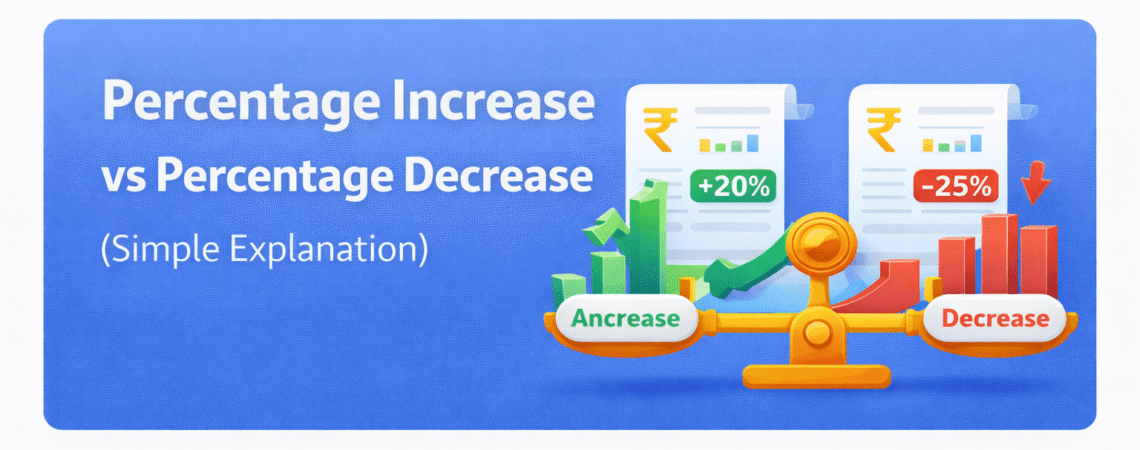
Percentage increase and percentage decrease are two concepts that people often confuse, even though they are used almost every day — in shopping, business, exams, salaries, and statistics.
If you’ve ever wondered:
- how much your salary increased,
- how big a discount really is,
- or whether numbers went up or down,
then understanding these two formulas will make things much easier.
Let’s break it down slowly and clearly, with real examples.
What Is Percentage Increase?
Percentage increase is used when a value goes up compared to its original value.
In simple words:
👉 Something became bigger than before.
Percentage Increase Formula
(New Value − Old Value) ÷ Old Value × 100
Example: Percentage Increase
Situation
Last year, your monthly expense was ₹10,000.
This year, it became ₹12,000.
Calculation
(12,000 − 10,000) ÷ 10,000 × 100
= 20%
Result
Your expenses increased by 20%.
What Is Percentage Decrease?
Percentage decrease is used when a value goes down compared to its original value.
In simple words:
👉 Something became smaller than before.
Percentage Decrease Formula
(Old Value − New Value) ÷ Old Value × 100
Example: Percentage Decrease
Situation
A product’s original price was ₹2,000.
After discount, the price is ₹1,500.
Calculation
(2,000 − 1,500) ÷ 2,000 × 100
= 25%
Result
The price decreased by 25%.
Read: Percentage change concept
Key Difference Between Percentage Increase and Decrease
| Point | Percentage Increase | Percentage Decrease |
|---|---|---|
| Direction | Value goes up | Value goes down |
| Formula base | Old value | Old value |
| Common use | Growth, salary, profit | Discount, loss, reduction |
📌 Important:
In both cases, the old value is always the base.
Real-Life Uses You See Every Day
📈 Salary & Income
- Salary hike → percentage increase
- Bonus reduction → percentage decrease
🛒 Shopping & Discounts
- Price raised → percentage increase
- Sale or offer → percentage decrease
📊 Business & Data
- Sales growth → increase
- Customer drop → decrease
🎓 Education
- Marks improvement → increase
- Marks loss → decrease
Common Mistakes People Make
Many people accidentally:
- use the new value as the base ❌
- mix increase and decrease formulas ❌
- forget to multiply by 100 ❌
👉 Always compare with the original value.
Percentage Increase Is NOT Reversed by Percentage Decrease
This is a very common confusion.
Example:
- Price increases by 20%
- Then decreases by 20%
❌ Final price will NOT be the same.
Why?
Because both percentages are calculated on different base values.
This is why understanding these formulas properly is important.
Quick Tip: Use a Calculator When Needed
If you don’t want to calculate manually every time, using an online calculator can save time and avoid mistakes.
You can use a Percentage Calculator on Misccalc to instantly find:
- percentage increase
- percentage decrease
- percentage difference
FAQs
Is percentage increase always higher than percentage decrease?
No. Both depend on the base value and the actual change.
Can percentage decrease be more than 100%?
No. A value cannot reduce more than its original amount.
Where are these formulas used most?
In finance, education, shopping, business analysis, and daily calculations.
Final Thoughts
Percentage increase and percentage decrease are simple concepts once you understand the logic behind them.
Just remember:
- Increase → new minus old
- Decrease → old minus new
- Always divide by the original value
With this clarity, you’ll never get confused again.