
If you’ve ever tried to buy flooring, paint a room, or even check a house listing, you’ve probably seen measurements written in square feet.
The problem? A lot of people don’t really know how square feet are calculated — they just guess.
And guessing can get expensive.
The good news is that calculating square feet is actually very easy, and once you understand it, you’ll never forget it. Let’s break it down in plain English.
What Does “Square Feet” Actually Mean?
A square foot is a unit used to measure area.
It simply means a space that is:
- 1 foot long
- 1 foot wide
So when someone says a room is 120 square feet, they’re talking about the total surface area, not how long or wide the room is by itself.
Square feet are commonly used in the United States for:
- Room and home sizes
- Apartments and real estate listings
- Flooring, carpet, and tile estimates
- Construction and remodeling projects
The Basic Square Feet Formula (No Math Stress)
Here’s the only formula you really need:
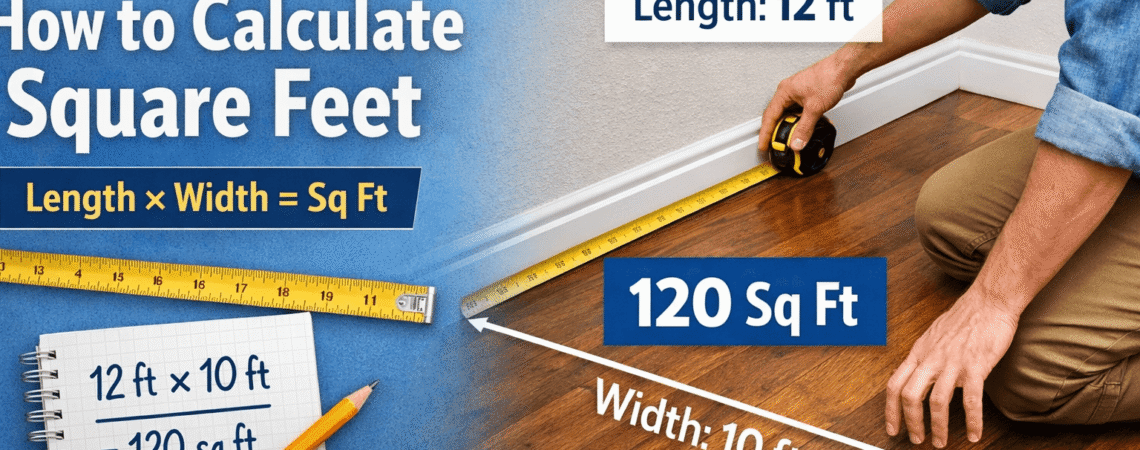
Square Feet = Length × Width
That’s it.
As long as both measurements are in feet, you’re good.
Example 1: Simple Room Measurement
Let’s say you measure a room and get:
- Length: 12 feet
- Width: 10 feet
Now multiply them:
12 × 10 = 120 square feet
That room is 120 sq ft.
How to Calculate Square Feet of a Room (Step by Step)
If this is your first time doing it, follow these steps:
- Measure the length in feet
- Measure the width in feet
- Multiply the two numbers
That’s all there is to it.
You don’t need special tools or apps — just a tape measure and a calculator (or the one on your phone).
Another Example (Real Life)
A bedroom measures:
- 14 feet long
- 11 feet wide
Calculation:
14 × 11 = 154 square feet
This is how builders, contractors, and real estate agents do it every day.
How to Calculate Square Feet for Irregular-Shaped Rooms
Not every room is a perfect rectangle. This is where people usually get confused.
Here’s the trick:
👉 Break the space into smaller rectangles.
Then:
- Calculate square feet for each section
- Add them together
Example:
- Section A: 10 × 8 = 80 sq ft
- Section B: 6 × 5 = 30 sq ft
Total area = 110 square feet
This method works for L-shaped rooms, hallways, and open layouts.
What If Your Measurements Are in Inches?
This happens a lot, especially when using small tape measures.
Just remember:
- 12 inches = 1 foot
So:
- Divide the calculated inches by 12 to convert to feet
- Then use the same formula
Example:
- Length: 120 inches → 10 feet
- Width: 96 inches → 8 feet
10 × 8 = 80 square feet
How to Calculate Square Feet for Flooring or Carpet
This is one of the most common reasons people search for square footage.
Here’s an important tip:
👉 Always add extra space for waste.
Most professionals recommend adding 5–10% extra.
Example:
- Room size: 200 sq ft
- Extra (10%): 20 sq ft
- Total flooring needed: 220 sq ft
I’ve personally seen people run short on materials just because they skipped this step.
Why Square Feet Calculations Matter
Getting square footage right helps you:
- Avoid buying too much or too little material
- Save money on flooring, paint, and tiles
- Understand real estate prices better
- Plan renovations accurately
Even a small measuring mistake can cost more than you expect.
📐 Related Area & Measurement Tools
Common Questions People Ask
How many square feet is a 10×10 room?
10 × 10 = 100 square feet
Is square footage the same as carpet area?
Not always. Carpet area usually excludes wall thickness and common areas.
Do I need special tools to calculate square feet?
No. A tape measure and a basic calculator are enough.
Final Thoughts
Once you calculate square feet a couple of times, it becomes second nature.
Whether you’re measuring a room for flooring, checking an apartment size, or planning a remodel, this simple calculation can save time, money, and frustration.
If you’re ever unsure, just use the calculator above — it’s quick and helps avoid mistakes.