
Percentages are used almost everywhere — in exams, shopping discounts, GST, profit and loss, and even salary hikes. Yet many people still feel confused when asked to calculate a percentage.
The good news is that percentage calculation is actually very simple once you understand the basic idea. This guide explains how to calculate percentage step by step, using clear language and real-life examples.
Percentage Calculator
Percentage Calculator
Quickly calculate percentages without doing manual calculations.
Try Calculator →Profit & Loss Calculator
Understand profit or loss using percentage-based calculations.
Calculate Now →What Is Percentage?
The word percentage means “out of 100.”
So:
- 10% means 10 out of 100
- 50% means 50 out of 100
- 100% means the whole amount
Once you remember this, percentage calculations become much easier.
Basic Formula to Calculate Percentage
The standard formula is:
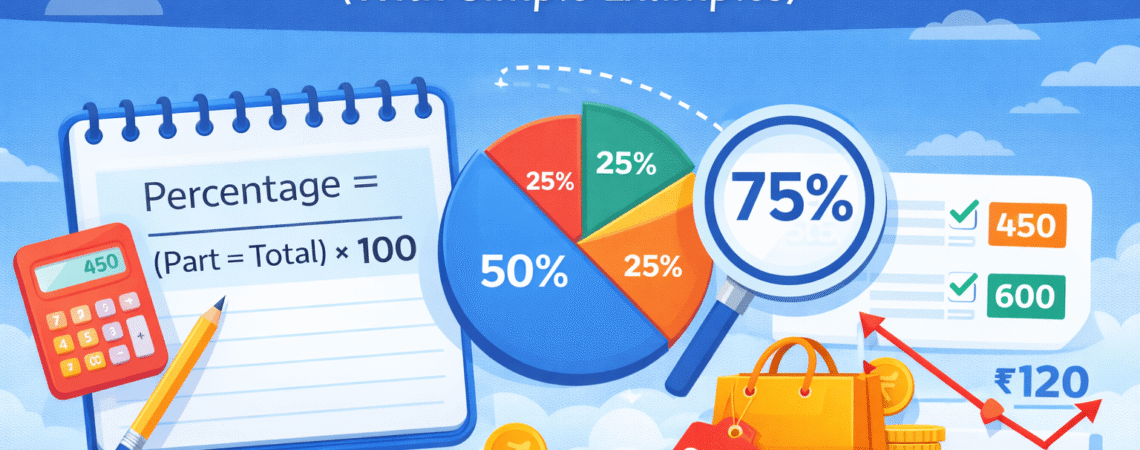
Percentage = (Part ÷ Total) × 100
Where:
- Part is the value you have
- Total is the full value
This formula works for almost all percentage problems.
Example 1: How to Calculate Exam Percentage
Suppose:
- You scored 450 marks
- Out of 600 marks
Calculation:
(450 ÷ 600) × 100 = 75%
✅ Your percentage is 75%.
This is the most common type of percentage calculation used by students.
Example 2: How to Find a Percentage of a Number
Question:
What is 20% of 500?
Steps:
20 ÷ 100 = 0.20
0.20 × 500 = 100
✅ 20% of 500 is 100.
This method is often used while calculating:
- Discounts
- GST
- Commission
Example 3: How to Calculate Percentage Increase
Let’s say:
- Old price = ₹100
- New price = ₹120
First, find the increase:
120 − 100 = 20
Now apply the formula:
(20 ÷ 100) × 100 = 20%
✅ The price increased by 20%.
Example 4: How to Calculate Percentage Decrease
Suppose:
- Old value = 200
- New value = 150
Difference:
200 − 150 = 50
Percentage decrease:
(50 ÷ 200) × 100 = 25%
✅ This is a 25% decrease.
Common Uses of Percentage in Daily Life
Percentages are used in many everyday situations, such as:
- Exam results and grades
- Shopping discounts
- GST and tax calculations
- Profit and loss in business
- Salary increases
Because percentages are so common, learning how to calculate them correctly is very useful.
Manual Calculation vs Percentage Calculator
You can calculate percentages manually for small numbers. However, for:
- Large values
- Repeated calculations
- GST, tax, or discount work
Using a percentage calculator is faster and helps avoid mistakes.
Tips to Avoid Mistakes While Calculating Percentage
- Always identify the total value correctly
- Don’t forget to multiply by 100
- Check whether the problem is asking for increase or decrease
- Use a calculator when numbers are large
These small checks can save you from common errors.
Frequently Asked Questions
How do I calculate percentage quickly?
Use the formula (Part ÷ Total) × 100 or a percentage calculator for faster results.
Can percentage be more than 100?
Yes. If the part is greater than the total, the percentage can be more than 100%.
Is percentage used only in maths?
No. Percentage is widely used in finance, shopping, exams, and business calculations.
Final Thoughts
Calculating a percentage is not difficult once you understand the basic formula. Whether you are a student, shopper, or working professional, knowing how to calculate percentage helps in many real-life situations.
Practice a few examples, and soon percentage calculations will feel natural.