
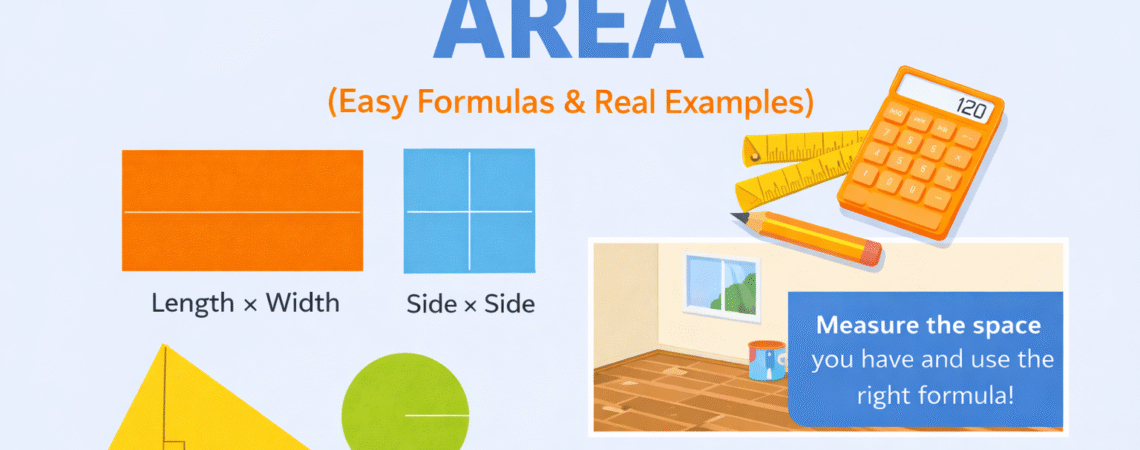
If you’ve ever tried to measure a room for flooring, check how much paint you need, or understand the size of a plot of land, you’ve already dealt with area — even if you didn’t realize it.
When people measure rooms for the first time, they often overlook small extensions or corners. I’ve seen this lead to wrong flooring orders more than once. Taking a few extra minutes to calculate area properly avoids that problem.
The problem is, many people think calculating area is complicated or “too math-heavy.”
It’s actually not.
Area Calculator
Once you understand the basic idea, calculating area becomes very simple and practical. Let’s go through it step by step, using real-life examples instead of classroom formulas.
What Is Area?
Area means the amount of space inside a shape.
Think of it this way:
- Length tells you how long something is
- Width tells you how wide it is
- Area tells you how much surface space it covers
Area is used every day in:
- Measuring rooms and houses
- Buying flooring or tiles
- Estimating construction costs
- Planning gardens or land use
That’s why knowing how to calculate area is genuinely useful.
Basic Area Formulas (You Only Need a Few)
You don’t need to memorize dozens of formulas. For most real-life situations, these are enough:
- Rectangle: Length × Width
- Square: Side × Side
- Triangle: ½ × Base × Height
- Circle: π × Radius²
Don’t worry if the circle formula looks unfamiliar — we’ll keep things practical.
How to Calculate the Area of a Rectangle
This is the most common calculation.
Formula:
Area = Length × Width
Example:
A room measures:
- Length: 12 feet
- Width: 10 feet
12 × 10 = 120 square feet
That’s the area of the room.
Most rooms, halls, and offices are rectangular, so this formula alone covers a lot of situations.
How to Calculate the Area of a Square
A square is just a rectangle where all sides are equal.
Formula:
Area = Side × Side
Example:
If one side of a square room is 9 feet:
9 × 9 = 81 square feet
Simple.
How to Calculate the Area of a Triangle
Triangles appear in roofs, land plots, and some design layouts.
Formula:
Area = ½ × Base × Height
Example:
- Base: 10 feet
- Height: 6 feet
½ × 10 × 6 = 30 square feet
Only the height that is perpendicular to the base should be used.
How to Calculate the Area of a Circle
Circles are common in gardens, tables, tanks, and round rooms.
Formula:
Area = π × Radius²
(π is approximately 3.14)
Example:
If the radius of a circular space is 7 feet:
3.14 × 7 × 7 = 153.86 square feet
You don’t need to calculate this manually every time — calculators make it easy.
How to Calculate Area of a Room (Real-Life Method)
For most homes and offices, here’s the easiest approach:
- Measure the length of the room
- Measure the width of the room
- Multiply the two numbers
That’s it.
If the room has an odd shape, don’t panic.
How to Calculate the Area of Irregular Shapes
Not all spaces are perfect rectangles. This is where many people get stuck.
According to area measurement, area represents the amount of space inside a shape.The trick is simple:
👉 Break the whole shape into smaller rectangles or squares.
Example:
An L-shaped room:
- Section A: 10 × 8 = 80 sq ft
- Section B: 6 × 5 = 30 sq ft
Total area = 110 square feet
This method works for:
- L-shaped rooms
- Hallways
- Open layouts
Area Measurement in Real Life
Here’s why area calculation really matters:
Flooring & Tiles
You need the correct area to avoid buying too much or too little material.
Painting Walls
Paint quantity depends on the wall area.
Construction & Renovation
Cost estimates are based on the total area.
Land Measurement
Plot size is always calculated using area.
Even small mistakes can lead to extra cost or wasted materials.
📐 Related Area & Measurement Tools
Common Questions About Area Calculation
What unit is area measured in?
Normally Area is measured in square units, such as:
- Square feet (sq ft), area
- Square meters (sq m)
Is area the same as perimeter?
No.
- Area = space inside
- Perimeter = distance around the edges
What is the easiest way to calculate area?
For most cases, measure length and width and multiply them. For complex shapes, use an online area calculator.
Final Thoughts
Calculating area doesn’t require advanced math skills. Once you understand what the area represents, the formulas become logical and easy to apply.
Whether you’re measuring a room, planning a renovation, or estimating material costs, knowing how to calculate area helps you make better decisions and avoid unnecessary expenses.
If you want quick and accurate results, using an area calculator can save time and prevent mistakes.