
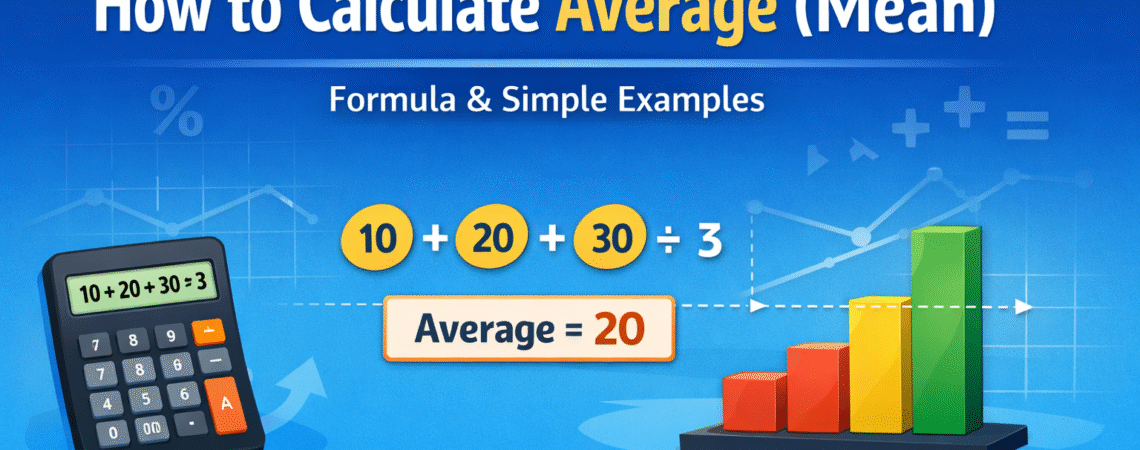
The concept of average is widely used in mathematics, statistics, and everyday calculations. Whether you are calculating exam scores, analyzing data, or measuring performance, the average helps summarize multiple values into a single number.
In this guide, we will explain how to calculate the average step by step using simple formulas and examples.
What Is an Average?
An average is a value that represents the central or typical value of a set of numbers.
The most common type of average is called the mean.
For example, if a student receives marks of 70, 80, and 90 in three exams, the average score helps represent overall performance.
Average Formula
The formula used to calculate the average is:
Average = Sum of All Values ÷ Total Number of Values
This formula works for most simple average calculations.
Step-by-Step Method
Let’s understand the calculation with simple steps.
Step 1: Add All Numbers
First, find the total sum of the numbers.
Example:
70 + 80 + 90 = 240
Step 2: Count the Numbers
In this case there are 3 values.
Step 3: Divide the Sum
Divide the total sum by the number of values.
240 ÷ 3 = 80
So the average score is 80.
Example 1
Find the average of:
10, 20, 30
Step 1:
10 + 20 + 30 = 60
Step 2:
Total numbers = 3
Step 3:
60 ÷ 3 = 20
Average = 20
Example 2
Find the average of:
5, 10, 15, 20
Step 1:
5 + 10 + 15 + 20 = 50
Step 2:
Total numbers = 4
Step 3:
50 ÷ 4 = 12.5
Average = 12.5
Example 3
Find the average of exam scores:
65, 70, 80, 85
Step 1:
65 + 70 + 80 + 85 = 300
Step 2:
Total values = 4
Step 3:
300 ÷ 4 = 75
Average score = 75
Where Average Is Used
Average calculations are used in many situations such as:
- Exam marks analysis
- Business performance reports
- Weather statistics
- Sports performance tracking
- Data analysis
Because averages summarize data, they are useful for understanding trends.
Common Mistakes to Avoid
While calculating averages, beginners sometimes make mistakes such as:
- Forgetting to count the total numbers correctly
- Dividing by the wrong value
- Missing numbers during addition
Always double-check your calculations.
Using an Average Calculator
For large data sets, manual calculation can be time-consuming.
An average calculator can quickly calculate the mean value by simply entering numbers.
This helps reduce calculation errors and saves time.
FAQs
What is the formula for average?
Average = Sum of values ÷ Number of values.
Is mean the same as average?
Yes, in most basic calculations mean and average refer to the same value.
Why is average important?
Average helps summarize data and makes it easier to compare values.
Final Thoughts
Calculating the average is one of the most useful mathematical skills. It helps simplify complex data and gives a clear picture of overall performance.
Remember the key formula:
Average = Sum of values ÷ Number of values
By following this simple method, you can easily calculate averages for any set of numbers.
Related Calculation Guides
- Percentage Calculator – Calculate Percentages Easily
- How to Calculate the Percentage of a Number
- How to Calculate Percentage Increase vs Decrease
Additional Learning Resources
To learn more about the concept of averages and basic statistics, you can explore reliable educational resources such as: