
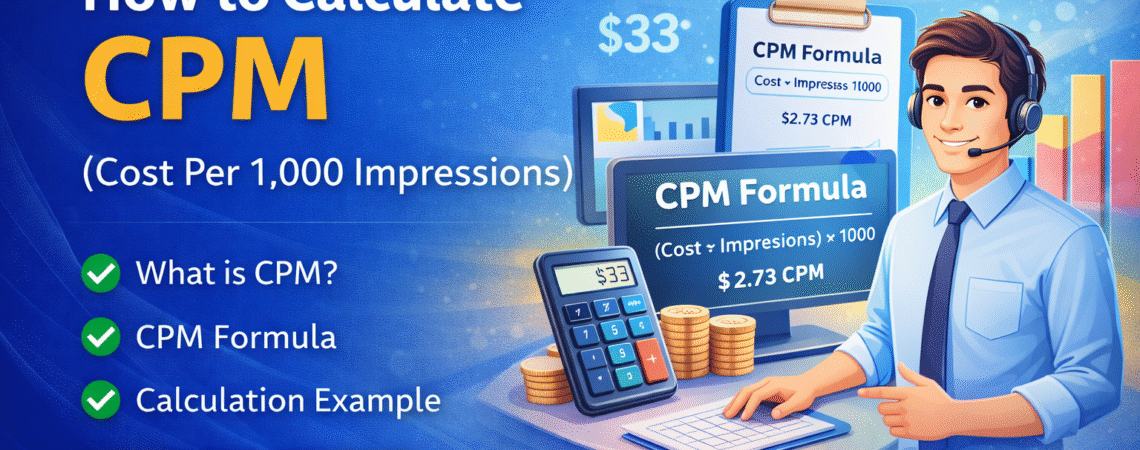
If you run online ads, manage YouTube monetisation, or analyse digital marketing campaigns, you have probably heard the term CPM. Understanding how to calculate CPM is essential for measuring advertising costs and comparing campaign performance.
In this guide, we will explain what CPM means, the formula used to calculate it, step-by-step examples, and how it differs from CPC and RPM.
What Is CPM?
CPM stands for Cost Per Mille, where mille means one thousand in Latin.
CPM represents the cost an advertiser pays for 1,000 impressions of an advertisement.
An impression means your ad is displayed once to a user. It does not necessarily mean the user clicked the ad — only that it was shown.
For example:
- If an advertiser pays $5 CPM,
- They pay $5 for every 1,000 ad impressions.
CPM is commonly used in:
- Display advertising
- YouTube ads
- Google Ads campaigns
- Social media ads
- Programmatic advertising
CPM Formula
The formula to calculate CPM is:
CPM = (Total Cost ÷ Total Impressions) × 1000
Where:
- Total Cost = amount spent on advertising
- Total Impressions = number of times the ad was shown
Step-by-Step Guide to Calculate CPM
Let’s understand it clearly.
Step 1: Identify the Total Cost
This is the amount you spent on your advertising campaign.
Example:
Total Cost = $33
Step 2: Identify the Total Impressions
This is the total number of times your ad was displayed.
Example:
Total Impressions = 12,100
Step 3: Divide Cost by Impressions
33 ÷ 12,100 = 0.002727
Step 4: Multiply by 1000
0.002727 × 1000 = 2.73
So, the CPM is:
$2.73
This means you paid $2.73 for every 1,000 impressions.
Another Example
Suppose:
- Total Cost = $250
- Total Impressions = 50,000
Step 1:
250 ÷ 50,000 = 0.005
Step 2:
0.005 × 1000 = 5
So the CPM is:
$5
This means you are paying $5 per 1,000 impressions.
Why CPM Is Important
CPM helps advertisers measure the cost efficiency of their campaigns.
It is useful when:
- You want brand awareness
- You want visibility instead of clicks
- You compare multiple ad platforms
- You manage display advertising
A lower CPM usually means you are getting impressions at a lower cost. However, lower is not always better if engagement is poor.
CPM vs CPC vs RPM
Many people confuse CPM with other advertising terms.
CPM (Cost Per 1,000 Impressions)
- Measures the cost for impressions
- Focuses on visibility
- Used by advertisers
CPC (Cost Per Click)
- Measures cost per click
- Focuses on traffic
- Used when clicks matter more than impressions
RPM (Revenue Per 1,000 Impressions)
- Used by publishers (like website owners)
- Measures how much revenue is earned per 1,000 impressions
In simple words:
- CPM = what the advertiser pays
- RPM = what publisher earns
When Should You Use CPM?
CPM works best for:
- Brand awareness campaigns
- Large audience targeting
- Display banner ads
- Video ads
- Social media promotion
If your goal is conversions or website traffic, CPC may be more suitable.
Common Mistakes When Calculating CPM
Avoid these common errors:
- Dividing impressions by cost instead of cost by impressions
- Forgetting to multiply by 1000
- Mixing up impressions and clicks
- Using inconsistent currency values
Always use accurate data from your ad platform dashboard.
How to Reduce CPM
If your CPM is too high, you can:
- Improve ad targeting
- Test different ad creatives
- Optimise audience selection
- Improve ad quality score
- Adjust bidding strategy
Better optimization often leads to improved campaign performance.
Use a CPM Calculator
Instead of calculating manually every time, you can use a CPM Calculator to get instant results.
Enter:
- Total Cost
- Total Impressions
And the calculator will show your exact CPM automatically.
This saves time and reduces calculation errors.
**According to Wikipedia, CPM (Cost Per Mille) is a common advertising pricing model used in digital marketing.
Frequently Asked Questions
What is a good CPM rate?
A good CPM depends on industry, audience, and platform. It varies widely between countries and niches.
Can CPM be negative?
No. Since cost and impressions are positive values, CPM cannot be negative.
Is lower CPM always better?
Not always. A low CPM with poor engagement may not give good results.
Does CPM guarantee conversions?
No. CPM only measures visibility, not clicks or sales.
Related Calculators & Guides
- Percentage Calculator – Quick Calculation Tool
- Discount Calculator – Calculate Price After Discount
- Percentage Increase & Decrease Guide
Final Thoughts
Understanding how to calculate CPM helps you make smarter advertising decisions. Whether you are running ads for a business, managing campaigns, or analyzing digital marketing data, knowing the CPM formula gives you clarity about your costs.
Use the formula:
CPM = (Cost ÷ Impressions) × 1000
Or use a CPM calculator for quick and accurate results.
Consistent tracking and analysis will help you improve campaign performance over time.