
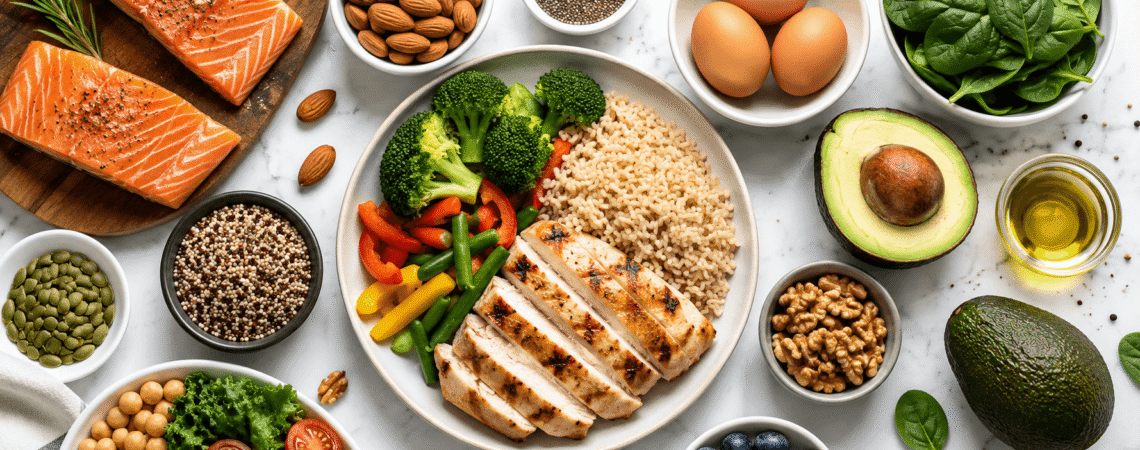
If you’ve ever spent 20 minutes staring at a nutrition label trying to figure out if a food “fits your macros,” you already know that macro tracking sounds simpler than it actually feels in practice.
Here’s the thing though — the concept itself is genuinely straightforward. Once you understand what macros are, what each one does, and how to calculate your personal targets, the whole thing clicks into place pretty quickly. This post walks you through all of that without the diet-culture noise.
What Are Macros, Exactly?
Macronutrients — or macros for short — are the three main categories of nutrients that provide your body with energy. Every food you eat contains some combination of them:
Protein builds and repairs muscle tissue, keeps you feeling fuller for longer, and has something called a thermic effect — meaning your body actually burns calories just digesting it (about 20–30% of protein calories, compared to 5–10% for carbs and almost nothing for fat). When you’re losing weight, protein is the macro that protects your muscle mass so the weight you lose is mostly fat.
Carbohydrates are your body’s preferred fuel source — especially for your brain and during moderate to intense exercise. They get a bad reputation, but carbs from whole foods (fruits, vegetables, whole grains, legumes) are genuinely important for energy, digestion, and performance. The problem isn’t carbs — it’s refined, processed carbs eaten in excess.
Fat supports hormone production, helps your body absorb fat-soluble vitamins (A, D, E, K), and provides long-lasting energy. Your body needs dietary fat to function. The type matters more than the total amount — unsaturated fats from avocados, olive oil, nuts, and fatty fish are the ones to prioritize.
Each macro provides a different amount of energy per gram:
- Protein: 4 calories per gram
- Carbohydrates: 4 calories per gram
- Fat: 9 calories per gram
This is why fat is more calorie-dense — a tablespoon of olive oil has more calories than a tablespoon of rice, even though the rice looks bigger.
Why Track Macros Instead of Just Calories?
You can lose weight by eating fewer calories than you burn — that part is non-negotiable. But two people eating the same number of calories can have very different results depending on where those calories come from.
Here’s a simple example:
Person A: Eats 1,800 calories/day — mostly processed foods, low protein, high refined carbs Person B: Eats 1,800 calories/day — high protein, balanced carbs, healthy fats
Both people are in the same calorie deficit. But Person A is likely losing muscle alongside fat (because there isn’t enough protein to preserve it), feels hungry most of the time (because processed food doesn’t keep you full), and has energy crashes through the day.
Person B is more likely to lose fat while preserving muscle, feel satisfied between meals, and maintain consistent energy.
Tracking macros doesn’t replace calorie tracking — it adds a layer of quality on top of it.
Step 1 — Figure Out Your Calorie Needs First
Before you can set macro targets, you need to know how many total calories you should be eating. This comes from your TDEE (Total Daily Energy Expenditure) — the number of calories your body burns in a day accounting for your activity level.
Our Calorie Calculator calculates this for you instantly. Enter your age, height, weight, gender, and activity level, and it gives you your maintenance calories.
From there, your goal determines your adjustment:
- Weight loss: Eat 300–500 calories below your TDEE
- Maintenance: Eat at your TDEE
- Muscle gain: Eat 200–350 calories above your TDEE
For most people starting out with weight loss, a 400–500 calorie daily deficit is a practical sweet spot — enough to lose roughly 0.5–1 lb per week without feeling miserable.
Step 2 — Set Your Macro Targets
Once you have your calorie target, split it into macros. Here are the ratios that are most commonly recommended, backed by nutrition research:
For Weight Loss
| Macro | Percentage | Why |
|---|---|---|
| Protein | 30–35% | Preserves muscle, keeps you full |
| Carbohydrates | 35–40% | Fuels workouts and brain |
| Fat | 25–30% | Hormones, satiety, vitamin absorption |
A commonly used split is 40% carbs / 30% protein / 30% fat — this works well for most active people trying to lose fat while maintaining muscle.
For Muscle Gain
| Macro | Percentage |
|---|---|
| Protein | 25–30% |
| Carbohydrates | 40–45% |
| Fat | 25–30% |
More carbs here because you need the energy to fuel and recover from training.
For Maintenance
| Macro | Percentage |
|---|---|
| Protein | 20–25% |
| Carbohydrates | 45–55% |
| Fat | 25–30% |
Step 3 — Convert Percentages to Grams
This is where people get confused, but the math is simple once you see it.
Example: You’re targeting 1,700 calories/day with a 40/30/30 split (carbs/protein/fat)
Carbs (40%): 1,700 × 0.40 = 680 calories from carbs 680 ÷ 4 = 170g of carbs
Protein (30%): 1,700 × 0.30 = 510 calories from protein 510 ÷ 4 = 127g of protein
Fat (30%): 1,700 × 0.30 = 510 calories from fat 510 ÷ 9 = 57g of fat
So your daily targets would be: 170g carbs / 127g protein / 57g fat
Don’t want to do this by hand every time? Use our Macronutrient Calculator — enter your details and it does all of this instantly, customized to your goal.
The Protein Rule That Matters Most
If there’s one macro to get right during weight loss, it’s protein.
Research from the American College of Sports Medicine consistently shows that 1.2–1.6 grams of protein per kilogram of body weight daily is optimal for preserving muscle during a calorie deficit.
For a 150-pound person (68 kg): that’s roughly 82–109g of protein per day.
Practically speaking, a lot of people are surprised by how much effort it takes to hit this number. Here are some high-protein foods that make it easier:
- Chicken breast (3 oz): ~26g protein
- Greek yogurt (1 cup): ~17g protein
- Eggs (2 large): ~12g protein
- Canned tuna (3 oz): ~22g protein
- Cottage cheese (½ cup): ~14g protein
- Lentils (½ cup cooked): ~9g protein
- Tofu (3 oz): ~8g protein
Building meals around a protein source first — then adding carbs and fat around it — is the most practical approach for hitting your numbers consistently.
How to Actually Track Your Macros
Knowing your targets is one thing. Hitting them daily is another.
Use a food tracking app. MyFitnessPal, Cronometer, and Lose It are the most widely used. You scan barcodes or search for foods, log portions, and the app tracks your running macro totals. Most people find that after a few weeks, they develop a strong intuitive sense of what’s in their food and rely on the app less.
Weigh your food, at least at first. Measuring cups are surprisingly inaccurate for things like nut butter, cheese, or cooked meat. A cheap kitchen scale removes the guesswork. This matters more for calorie-dense foods (fats, nuts, oils) than it does for vegetables.
Aim for close, not perfect. You don’t need to hit your macros exactly every day. Being within 5–10g on protein, carbs, and fat is close enough. Consistency over weeks matters far more than precision on any given day.
Don’t obsess over single foods. Macros are about daily totals, not individual meals. If breakfast was higher in carbs than you planned, you can balance it at lunch. The whole day is the unit that matters, not each meal in isolation.
The One Thing Most People Get Wrong
Most people who start tracking macros focus too much on carbs and fat — specifically, trying to minimize both — while not paying enough attention to whether they’re actually hitting their protein target.
The research is pretty clear: when protein is adequate and calories are controlled, the exact carb-to-fat split matters much less than most diet plans imply. Low-carb, high-carb, moderate carb — they all produce similar fat loss results when protein and total calories are matched.
What this means practically: if you find that a higher-carb approach keeps you fuller and more energized for your workouts, you don’t need to force yourself onto a low-carb plan just because it’s popular. Find the carb-to-fat ratio you can sustain. Hit your protein. Stay in your calorie target.
That’s genuinely most of it.
How Long Before You See Results?
With a 400–500 calorie daily deficit and adequate protein, most people see:
- Week 1–2: Some initial water weight loss (often 2–4 lbs) as glycogen stores reduce
- Week 3–6: True fat loss becomes visible — roughly 0.5–1 lb per week
- Month 2–3: Noticeable body composition change, especially if paired with strength training
A note on plateaus: as you lose weight, your TDEE drops because your body has less mass to maintain. If progress stalls after several weeks, recalculate your calorie target with your new body weight — the math changes as you change.
Frequently Asked Questions
Do I need to count macros forever? No. Most people use macro tracking for a few months to build nutritional awareness, then maintain their results more intuitively. It’s a calibration tool, not a permanent lifestyle requirement.
What if I go over my macros one day? It doesn’t undo your progress. One day’s overage rarely matters; it’s what you do consistently over weeks that determines your results. Just get back on track the next day.
Is IIFYM (If It Fits Your Macros) healthy? IIFYM — eating any food as long as it hits your macro targets — works for weight loss from a purely numerical standpoint. Whether it’s healthy depends entirely on what foods you choose. Hitting 150g of protein via candy and processed food has different health effects than hitting it via lean meat, legumes, and dairy. The macro framework doesn’t care, but your body does.
What’s the difference between net carbs and total carbs? Net carbs = total carbs minus fiber. Fiber isn’t digested and doesn’t meaningfully contribute to blood sugar or calorie absorption. Low-carb diet plans (like keto) typically track net carbs. Standard macro tracking uses total carbs.
Should I adjust my macros on rest days vs. training days? Many people don’t bother, and that’s fine for most goals. More advanced approaches cycle carbs — higher carbs on training days, lower on rest days — but this level of precision isn’t necessary unless you’re an athlete optimizing for performance.
Learn More From Trusted Sources
The USDA Dietary Guidelines for Americans (2020–2025) outlines the recommended macronutrient ranges for the general adult population: Dietary Guidelines — Macronutrients
The National Institute of Diabetes and Digestive and Kidney Diseases (NIDDK) offers evidence-based guidance on energy balance and weight management: NIDDK — Weight Management
More tools on MiscCalc: Macronutrient Calculator · Calorie Calculator · Body Fat Calculator · BMI Calculator