
Most people have a rough idea of what they weigh. Fewer know their body fat percentage — and that’s actually the number that tells you more about your health.
Your weight on a scale includes everything: muscle, bone, water, organs, and fat. Body fat percentage isolates just the fat portion and shows you what proportion of your body it makes up. Two people can weigh exactly the same and have completely different health pictures — one lean and muscular, the other carrying excess fat — because their body composition is different.
This guide explains what body fat percentage actually means, what ranges are considered healthy for men and women, and how to figure out where you stand.
What Body Fat Percentage Actually Measures
Body fat percentage = (total fat mass ÷ total body weight) × 100
So if you weigh 70 kg and carry 14 kg of fat, your body fat percentage is 20%.
The rest — your lean mass — includes muscle, bone, water, and organs. Lean mass is the part of your body that does work: it burns calories, moves you around, and keeps your metabolism running.
Fat isn’t purely bad. Your body needs a certain amount of it to survive — for hormone production, organ protection, insulation, and vitamin absorption. The question is whether you’re carrying too much, too little, or roughly the right amount.
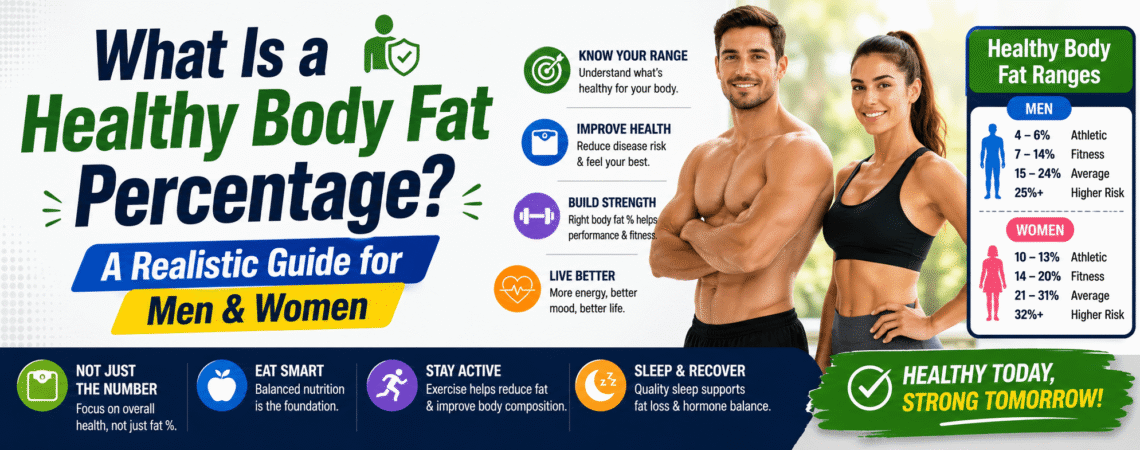
Healthy Body Fat Percentage Ranges
These are the widely referenced ranges from the American Council on Exercise (ACE), which are used globally across health and fitness fields.
For Men
| Category | Body Fat % |
|---|---|
| Essential fat (minimum) | 2–5% |
| Athletes | 6–13% |
| Fit | 14–17% |
| Acceptable / Average | 18–24% |
| Obese | 25%+ |
For Women
| Category | Body Fat % |
|---|---|
| Essential fat (minimum) | 10–13% |
| Athletes | 14–20% |
| Fit | 21–24% |
| Acceptable / Average | 25–31% |
| Obese | 32%+ |
Women naturally carry more body fat than men — this isn’t a health issue, it’s biology. Female bodies need higher fat reserves to support hormonal function, reproductive health, and vitamin absorption. This is why the “healthy” ranges are higher for women across every category.
How Body Fat Changes with Age
These ranges aren’t fixed for life. As you get older, your body naturally tends to hold more fat and less muscle — even if your weight on the scale stays the same.
A 25-year-old man at 20% body fat and a 55-year-old man at 20% body fat are in different situations. The older person has had decades of muscle loss working against them, so maintaining 20% as they age actually takes more effort.
The general principle: acceptable body fat percentages shift upward slightly with each decade. What’s healthy at 30 is different from what’s healthy at 60. If you’re over 50 and your body fat is creeping into the “average” zone, the more important focus is maintaining muscle mass — not just lowering the fat number.
Why Body Fat Percentage Beats BMI for Tracking Fitness
BMI is useful as a quick screening tool — it’s fast, free, and needs nothing more than height and weight. But it doesn’t distinguish between fat and muscle.
Here’s where it breaks down:
The muscular person problem: A rugby player or bodybuilder may have a BMI in the “overweight” range because muscle is denser and heavier than fat. Their actual health risk is low, but BMI flags them anyway.
The “skinny fat” problem: Someone can have a completely “normal” BMI — say 22 — while carrying very little muscle and a relatively high proportion of body fat. This is sometimes called being “skinny fat” and comes with real metabolic risks that BMI misses entirely.
Body fat percentage catches both of these cases because it directly measures fat — not just the ratio of weight to height.
That said, body fat percentage has its own limitations. It doesn’t tell you where your fat is stored, which matters significantly. Visceral fat — the fat stored around your organs in the abdominal area — is more metabolically dangerous than subcutaneous fat under the skin. Two people with the same body fat percentage can have very different health risks depending on fat distribution.
How to Measure Body Fat Percentage
There are several methods, ranging from rough estimates to clinical precision.
1. Body fat calculator (measurements method)
Using measurements of your waist, hips, and neck, you can estimate body fat percentage using a formula. It’s not the most precise method but it’s free, done at home, and surprisingly accurate for most people when done consistently. Try our free Body Fat Calculator for an instant estimate.
2. Bioelectrical impedance (BIA)
Many bathroom scales and gym machines now include this. A small electrical current passes through your body — fat and muscle conduct electricity differently, and the device estimates your composition from the result. Accuracy varies significantly depending on hydration levels and time of day. Useful for tracking trends over time rather than getting an exact number.
3. Skinfold calipers
A trained professional pinches specific areas of skin and measures the fold thickness. Cheap and reasonably accurate when done consistently by the same person. Less useful if you’re doing it yourself.
4. DEXA scan
A full-body X-ray that produces a detailed breakdown of fat, muscle, and bone density — by region of the body, not just total. The most accurate non-invasive method available. Used in clinical settings and some specialist gyms. Can be pricey depending on where you are.
5. Hydrostatic weighing
You’re weighed underwater. Fat floats and muscle sinks, allowing very precise calculations. Highly accurate but not exactly accessible for most people.
For most people, the measurements-based calculator or bioelectrical impedance scale is the most practical starting point. The goal is consistency — pick one method and track changes with it over time rather than chasing one perfect number.
What to Do If You’re Outside the Healthy Range
If your body fat is too high:
The well-worn answer is still the right one: a combination of resistance training (to build and maintain muscle) and a modest calorie deficit (to gradually lose fat). Crash diets that eliminate calories too aggressively tend to burn muscle along with fat, which worsens your body composition even if the scale goes down.
Tracking your body fat percentage every 4–6 weeks — rather than daily weigh-ins — gives a clearer picture of whether you’re actually losing fat or just losing water weight.
If your body fat is too low:
This is less common but not rare, particularly among endurance athletes and people with restrictive eating patterns. Going below essential fat levels affects hormone production, bone density, immune function, and energy. If you suspect this, speaking with a doctor or registered dietitian is the right step.
If you’re within range but want to improve:
The priority is muscle maintenance — especially as you age. Even a moderate strength training routine 2–3 times per week makes a significant difference in body composition over years, independent of weight.
Use our Calorie Calculator to understand your daily energy needs, and our Ideal Weight Calculator to get a sense of where a healthy body composition sits for your height.
🌍 Trusted Health Resources
- CDC Healthy Weight Guide – Official information about healthy weight, BMI, and body composition.
- NHLBI Body Weight Resources – Learn how body fat, BMI, and healthy weight ranges are measured.
- World Health Organization (WHO) – Global health information about obesity, body fat, and healthy lifestyle recommendations.
The Number Isn’t Everything
Body fat percentage is a more useful number than BMI for understanding health, but it’s still just one number. How you feel, how you perform, your energy levels, your strength, your blood markers — these all matter more than hitting a specific percentage.
The healthiest approach isn’t to chase the leanest possible body. It’s to maintain enough muscle to stay strong and functional, keep fat within a range that doesn’t increase disease risk, and build habits that are sustainable over years — not weeks.
Use the Body Fat Calculator to find where you are right now. Then use that number as a baseline, not a verdict.
Quick Reference
- Body fat % = fat mass ÷ total body weight × 100
- Healthy range for men: 14–24% (varies by age and activity level)
- Healthy range for women: 21–31% (varies by age and activity level)
- Women naturally carry more fat — this is normal and necessary
- Body fat % beats BMI for identifying “skinny fat” and muscular people
- Best for most people: measurements-based calculator or consistent BIA scale
- Goal: stay within healthy range + maintain muscle, not just minimise fat
Explore more health tools on MiscCalc: Body Fat Calculator · BMI Calculator · Ideal Weight Calculator · Calorie Calculator