
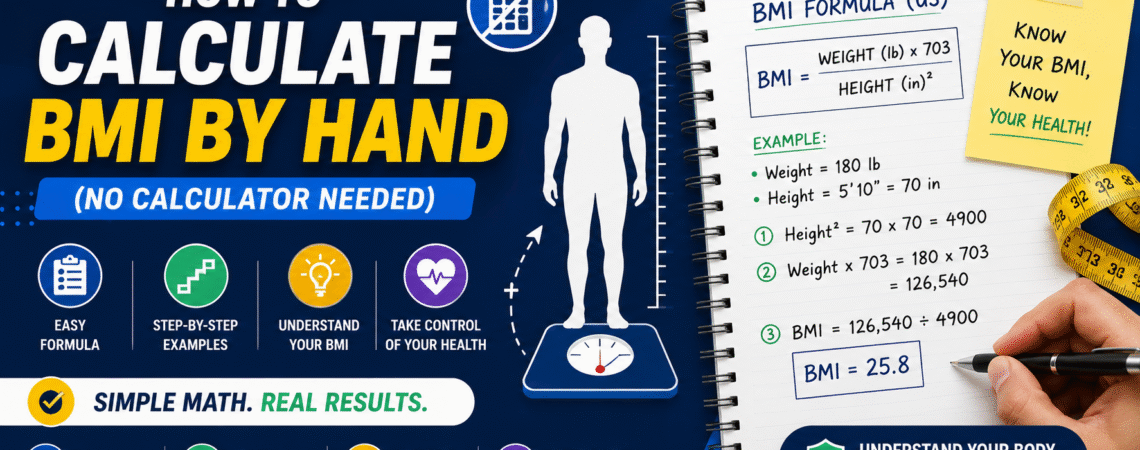
Most people check their BMI with an online calculator and move on without really understanding what’s happening behind the scenes. That’s fine — but knowing how the number actually gets calculated changes the way you interpret it.
This post walks you through the BMI formula step by step, so you can work it out yourself, on paper if you want. No app needed, no login, no nonsense.
What Is BMI, Really?
BMI stands for Body Mass Index. It’s a number that compares your weight to your height and gives you a rough sense of whether you’re in a healthy weight range for your body size.
It was developed in the 1800s by a Belgian statistician named Adolphe Quetelet, which is why it’s sometimes called the Quetelet Index. It wasn’t designed as a health tool — it was a way to study body size across large populations. But it became standard in medicine because it’s fast, free, and needs nothing more than a scale and a tape measure.
Is it perfect? No. We’ll get to that. But it’s a useful starting point.
The BMI Formula
There are two versions, depending on whether you use metric or imperial measurements.
Metric (kg and cm)
This is the simpler version:
BMI = weight (kg) ÷ height (m)²
You divide your weight in kilograms by your height in metres squared.
Imperial (lbs and inches)
BMI = [weight (lbs) ÷ height (inches)²] × 703
The 703 is a conversion factor that makes the two formulas produce the same result.
Step-by-Step: How to Calculate BMI
Let’s work through a real example so it’s completely clear.
Example person: 70 kg, 175 cm tall
Step 1 — Convert height to metres
175 cm ÷ 100 = 1.75 m
Step 2 — Square your height
1.75 × 1.75 = 3.0625
Step 3 — Divide weight by that number
70 ÷ 3.0625 = 22.86
That’s the BMI. In this case, 22.86 — which falls in the “Normal weight” range.
Let’s try it with imperial measurements too.
Example person: 154 lbs, 5’9″ tall (69 inches)
Step 1 — Convert height to total inches
5 feet = 60 inches, plus 9 = 69 inches
Step 2 — Square your height
69 × 69 = 4,761
Step 3 — Divide weight by height squared
154 ÷ 4,761 = 0.03234
Step 4 — Multiply by 703
0.03234 × 703 = 22.74
Almost identical result — as it should be.
What Your BMI Number Means
Once you have your number, here’s how to read it:
| BMI Range | Category |
|---|---|
| Below 18.5 | Underweight |
| 18.5 – 24.9 | Normal weight |
| 25.0 – 29.9 | Overweight |
| 30.0 and above | Obese |
These are the categories used by the World Health Organization, so they apply globally — not just in one country.
The Part Nobody Talks About
Here’s something that might surprise you: BMI doesn’t measure fat.
It measures the ratio of weight to height. That’s it. It has no idea what that weight is made of — whether it’s muscle, bone, fat, or water.
This creates some well-known blind spots:
Athletes often show as “overweight.” A 90 kg rugby player and a 90 kg sedentary office worker will have the same BMI, even though their body compositions are completely different. Muscle is denser than fat, so muscular people tend to weigh more than you’d expect for their height.
Older adults can have a “normal” BMI and still carry too much fat. As people age, muscle mass tends to decrease and fat increases. Your weight on a scale might stay the same, but your body composition shifts.
BMI doesn’t account for where fat is stored. Fat around the belly (visceral fat) is more dangerous than fat around the hips or thighs. BMI can’t distinguish between the two.
None of this means BMI is useless. At a population level, it’s a decent screening tool. But for individuals — especially athletes, older adults, and people with higher muscle mass — it tells an incomplete story.
A More Complete Picture
If you want to go beyond BMI, a few additional measurements can help:
Waist circumference — A waist over 80 cm (women) or 94 cm (men) is associated with higher health risks, regardless of BMI.
Body fat percentage — A more direct measure of how much of your body is fat versus lean mass. You can estimate it with a Body Fat Calculator using measurements like waist, hips, and neck.
Waist-to-height ratio — Some researchers argue this is a better predictor of cardiovascular risk than BMI. The rough guideline: your waist should be less than half your height.
These don’t replace medical advice, but they paint a fuller picture than BMI alone.
Don’t Want to Do the Maths Every Time?
Completely understandable. If you want an instant answer, our free BMI Calculator does the calculation in seconds — metric or imperial, no signup, no ads cluttering your result.
But now that you understand the formula, the number means something. You’re not just getting a label — you know exactly how it was derived and what its limits are.
Quick Reference
- BMI formula (metric): weight (kg) ÷ height (m)²
- BMI formula (imperial): [weight (lbs) ÷ height (in)²] × 703
- Normal range: 18.5 – 24.9
- BMI doesn’t measure fat — it measures the ratio of weight to height
- For a fuller picture: combine BMI with waist circumference or body fat %
Looking for more health tools? Try the Body Fat Calculator, Calorie Calculator on MiscCalc.
🌍 Helpful Health Resources
- CDC BMI Guide – Official information about BMI, healthy weight ranges, and body mass index basics.
- NHLBI BMI Information – Learn how BMI is calculated and how it relates to overall health.
- World Health Organization (WHO) – Global health information about obesity, overweight, and BMI guidelines.
❓ FAQ Section
1. Can I calculate BMI without a calculator?
Yes, you can calculate BMI manually using simple multiplication and division.
2. What is a healthy BMI range?
A BMI between 18.5 and 24.9 is generally considered healthy.
3. Is BMI accurate for everyone?
Not always. BMI doesn’t account for muscle mass, body composition, or age.
4. Why is 703 used in the BMI formula?
The number 703 is a conversion factor used for pounds and inches in the US formula.
5. Is BMI the same for men and women?
The BMI formula is the same, but body composition may differ.